
Avoiding Cheap Looking Custom Merchandise: 7 Tips
Table of Contents
- Why Custom Merchandise Often Looks Cheap (and How to Spot It Early)
- Custom Merchandise Design Tips That Instantly Lift Perceived Quality
- Custom Apparel Design Mistakes That Scream Amateur
- Custom Merchandise Printing Methods and the Finish They Give
- Why You Should Order Custom Merchandise Samples Before a Bulk Order
- A Quick Checklist for Judging Quality Before You Commit
- Conclusion
- Frequently Asked Questions
Last Updated: October 5, 2026
Why Custom Merchandise Often Looks Cheap (and How to Spot It Early)
Most cheap-looking custom merchandise fails for one reason: the design was built for a screen, not for the material it ends up on. A logo that looks sharp on a laptop can turn muddy the moment it's printed on cotton or engraved into metal.
The problem usually starts before production. Someone picks a supplier on price, sends a low-res file, and hopes for the best. What comes back looks like a giveaway, not a brand asset.
This guide walks through the seven things that separate premium custom merchandise from the pile of forgotten freebies. We'll cover design, materials, printing methods, and the checks that catch problems before you commit to a bulk order.
According to GOV.UK guidance on selling goods, anything you sell or give away as branded merchandise still has to meet basic quality and safety standards. Cheap-looking items often fail on both.
Custom Merchandise Design Tips That Instantly Lift Perceived Quality
Good design is the fastest way to make custom merchandise look expensive. Two changes do most of the work: giving your artwork space, and keeping fonts and colours consistent with your brand.
Give Your Design Room to Breathe
Crowded designs look cheap. Every element needs space around it.
- Leave at least 10mm of clear space around any logo
- Use one main image, not three competing ones
- Cut text to the essentials: name, tagline, one contact detail
- Avoid borders that touch the edge of the item
A single, well-spaced logo on a plain tote bag reads as premium. Five logos crammed together reads as a discount promo.
Match Fonts and Colours to Your Brand
Sticking to two fonts and two or three brand colours keeps things clean. More than that and the item starts to look homemade.
Use the same colour codes across every item. If your brand blue is a specific hex value, that value should appear on the tote, the tag, and the card. Small mismatches are what make a set look off.
Custom Apparel Design Mistakes That Scream Amateur
Apparel is where most custom merchandise goes wrong. The two biggest culprits are bad artwork files and poor placement on the garment.
Low-Resolution Logos and Stretched Artwork
A logo needs to be a vector file, not a screenshot or a JPEG pulled from a website. Vector files scale to any size without blurring.
If you only have a low-res image, it will look fuzzy when printed. Stretched artwork is worse. It distorts the shape and makes the whole garment look rushed.
Ask your designer for these file types before you send anything to print:
- .AI or .EPS (vector, best for print)
- .PDF (vector, widely accepted)
- .PNG at 300dpi minimum (raster, backup only)
Sizing and Placement Errors on Garments
Placement is a quiet killer. A logo 2cm too low on a t-shirt looks wrong, even if no one can say why.
Standard placement for a left-chest logo is roughly 7-10cm down from the shoulder seam. Centre chest prints usually sit 5-8cm below the collar. Get these wrong and the garment looks off-the-peg in the worst way.
Custom Merchandise Printing Methods and the Finish They Give
The printing method decides how the finished item feels and how long it lasts. Vinyl transfers peel. Screen printing cracks over time. Engraving doesn't.
Premium Metal Business Cards →
Here's how the main methods compare:
| Method | Best For | Finish | Durability |
|---|---|---|---|
| Screen print | Bulk apparel | Flat, bold colour | Fades with washing |
| Vinyl transfer | Small runs, names | Slight raised edge | Can peel |
| Dye sublimation | All-over prints | Smooth, no texture | Very good |
| Laser engraving | Metal, wood, leather | Recessed, permanent | Excellent |
When Engraving Beats Print for a Premium Look
Engraving wins when you want an item to feel permanent and considered. It cuts into the material rather than sitting on top of it.
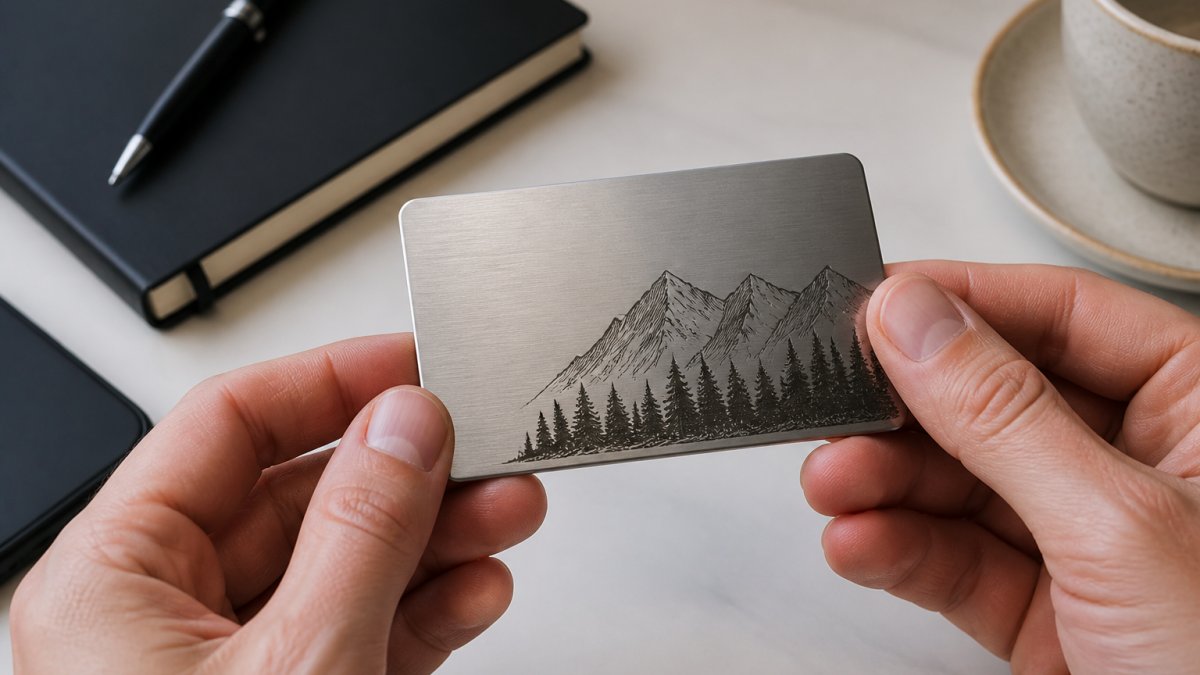
Metal business cards are a good example. Our Premium Metal Business Cards are 0.8mm thick, scratch resistant, and can be engraved on both sides. Detailed logos hold up well because the engraving is cut, not printed. We can also create a custom QR code to send contacts straight to your key information, so the card keeps working for you.

For more on how engraving fits into wider branding, the Design Council's resources on design quality are worth a look.
Why You Should Order Custom Merchandise Samples Before a Bulk Order
A sample is the cheapest insurance you'll ever buy. It shows you the real colour, weight, and finish before you spend on volume.
Order one of each item you're considering. Check it in daylight, not just under office lights. Feel the weight. Look at the edges.
If a sample feels thin or the print sits unevenly, that problem multiplies across 500 units. Never skip this step to save time.
A Quick Checklist for Judging Quality Before You Commit
Run through this list before you approve any bulk order. It catches the problems that make custom merchandise look cheap.
- Artwork supplied as vector (.AI, .EPS, or .PDF)
- Logo has at least 10mm clear space on all sides
- No more than two fonts and three brand colours used
- Placement measured against standard garment positions
- Printing or engraving method matches the material
- Sample ordered and checked in daylight
- Colour match confirmed against brand codes
- Edges, stitching, and finish inspected by hand
- Supplier confirmed turnaround before you commit
If any box is unticked, fix it before you order. One weak link makes the whole run look cheap.
Conclusion
Getting custom merchandise that looks premium comes down to the details: clean artwork, the right method, and a sample you've actually checked. Skip any of those and the finished item shows it.
At FOG Creative, we handle bespoke laser engraving and customisation for businesses and individuals. We work with your own items, deliver precision from our North West London base, and turn rough ideas into finished pieces that look the part. Whether it's metal business cards or a full branded run, we make sure the details hold up.
Get started with FOG Creative and order merchandise you're proud to hand out.
Frequently Asked Questions
How do you make custom merchandise look more premium?
Start with a clean design that gives your logo room to breathe, then pick a method that suits the material. Laser engraving on metal, for example, produces a permanent, scratch-resistant finish that reads as high quality, unlike a flat print that can crack or fade. Ordering a sample before a bulk run lets you check line sharpness, colour accuracy and material weight so nothing looks cheap when it arrives.
What design mistakes make branded clothing look unprofessional?
The most common custom apparel design mistakes are stretched or low-resolution logos, oversized graphics that swamp the garment, and fonts that clash with the brand. Placement matters too: a print that sits too low or off-centre looks rushed. Keep the artwork vector-based, limit yourself to two fonts, and check the placement on a physical sample before approving a full run.
Which printing methods give custom merchandise a professional finish?
It depends on the material. Screen printing suits bold, simple designs on fabric, while embroidery adds texture and durability to polo shirts and caps. For metal and hard goods, laser engraving cuts the design into the surface so it cannot peel or rub off. Ask your supplier which custom merchandise printing methods suit your specific item, then request a sample to compare the finish.
Is it worth ordering a sample before buying custom merchandise in bulk?
Yes. A sample is the only way to confirm how a design translates onto the actual material before you commit to hundreds of units. Check the engraving or print depth, colour accuracy, and how the item feels in hand. It also gives you a chance to catch layout errors early. Suppliers like FOG Creative can work with customer-provided items, so you can test the exact product you plan to order.