
7 Differences in Laser Engraving vs Screen Printing Quality
Last Updated: 2 November 2026
Quick Summary
Laser engraving produces a permanent, high-resolution mark by removing or altering the material itself, so it cannot peel, flake or wash away. Screen printing lays down thicker, more vivid ink in a full colour palette, but that ink can crack, fade or wear over time. Choose laser engraving for metal, glass or wood where durability and fine detail matter most.
- Laser engraving is subtractive, so there is no ink to peel, flake or wash away.
- Screen printing offers a full colour palette but its ink can crack, fade or wear.
- Strokes below roughly 0.2 mm become unreliable in screen printing on curved substrates.
- Once settings are locked, laser engraving reproduces marks consistently across long metal runs.
- We offer a 10% discount on bulk equipment engraving orders of ten or more items.
Table of Contents
- How Laser Engraving and Screen Printing Create a Mark
- Laser Engraved vs Screen Printed Drinkware: A Side-by-Side Comparison
- Screen Printing Durability Under Real-World Use
- Laser Engraving Material Compatibility: Where Each Method Works
- Fine Detail, Gradients and Small Text: Which Method Holds Up
- Colour Range, Matching and Batch Repeatability
- Cost Per Unit and Setup Time for Short and Long Runs
- Choosing the Right Finish for Your Products
- Frequently Asked Questions
How Laser Engraving and Screen Printing Create a Mark
Laser engraving versus screen printing quality comes down to one difference: one method removes material, the other adds ink. That distinction shapes how long a mark lasts and how fine the detail can go. The quality gap between the two is narrower than many guides suggest. Below, we break down where each method wins, where it falls short, and how to choose.
Material Removal: What a Laser Actually Does
Laser engraving is a subtractive process. A focused beam of light vaporises or fractures the surface layer of the substrate, leaving a permanent mark that sits below the original surface level.
The mark has real depth, you can feel it with a fingernail, and will not peel, flake or wash away because there is no ink to lose.
Contrast comes from the material itself. On anodised aluminium, the laser burns through the coloured layer to reveal the lighter metal underneath. On stainless steel, it creates a darkened, oxidised surface. Neither approach uses a single drop of ink.
Ink Deposition: What Screen Printing Adds
Screen printing is an additive process. Ink is pushed through a mesh stencil onto the substrate, then cured with heat or UV light.
That layering gives screen printing its defining strength: rich, opaque colour on almost any surface. Screen printing can lay down thick, vivid ink on fabric, plastic and coated drinkware. The trade-off is that the ink sits on top of the surface, where it can wear, crack or fade over time.
Laser Engraved vs Screen Printed Drinkware: A Side-by-Side Comparison
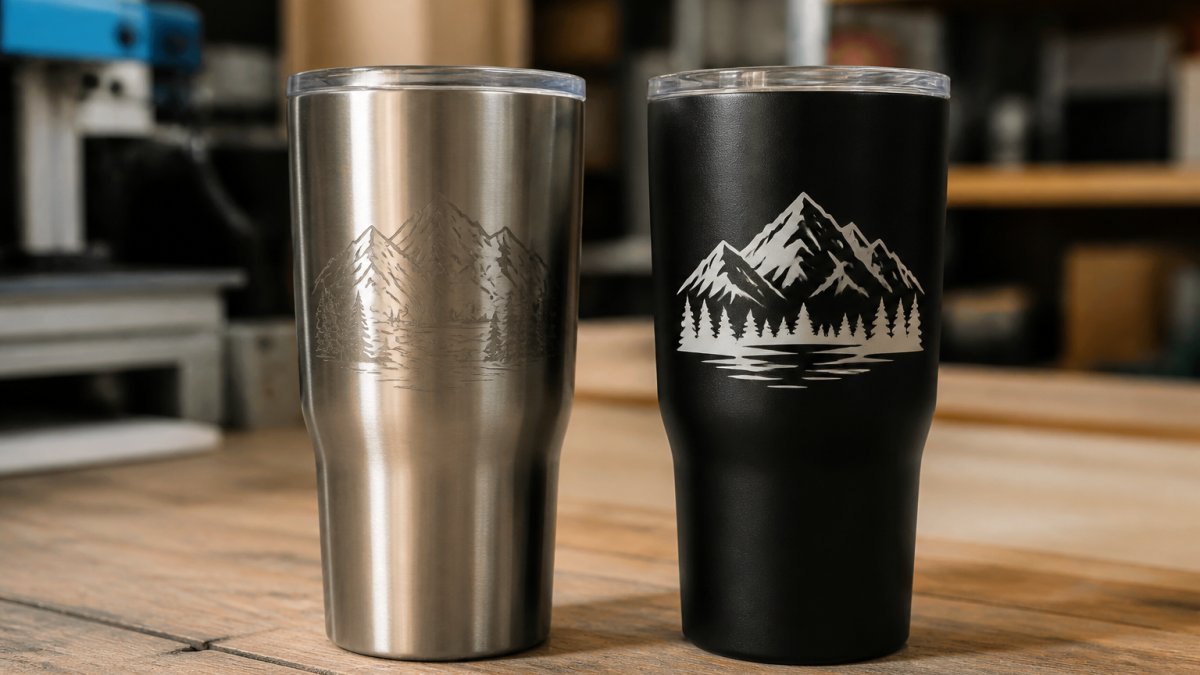
Drinkware is where the two methods get compared most often. A laser-etched tumbler and a screen-printed one can look similar on day one; six months of dishwashing later, they rarely do.
| Criterion | Laser Engraving | Screen Printing |
|---|---|---|
| How the mark is made | Material removed or altered | Ink deposited and cured |
| Durability | Permanent, cannot peel | Can crack, fade or wear |
| Colour range | Limited to substrate contrast | Full colour palette available |
| Fine detail | Excellent, high resolution | Limited by mesh count |
| Gradients | Not possible | Achievable with halftones |
| Best substrates | Metal, glass, wood, coated plastic | Fabric, plastic, coated surfaces |
| Setup time | Short, digital file to machine | Longer, screen preparation required |
| Cost per unit at volume | Low | Very low |
| Cost for one-offs | Affordable, no setup | Expensive, setup dominates |
The pattern is clear. Screen printing wins on colour and volume economics. Laser engraving wins on permanence, precision and short runs.
If you want a practical checklist for judging engraving quality before committing, our guide on how to verify custom engraving quality walks through what to inspect.
Screen Printing Durability Under Real-World Use
Screen printing durability depends on the ink, the cure and the substrate. Get all three right and a print survives years; get any one wrong and it fails early.
Wash and abrasion resistance are the two tests that matter most for drinkware and apparel.
Laser marks do not face the same risk. There is no ink to cure, so there is nothing to under-cure. UV resistance and chemical resistance come from the substrate rather than a coating.
Laser engraving cannot mark fabric the same way, so the two methods often sit side by side in a merchandise range rather than competing directly.
Laser Engraving Material Compatibility: Where Each Method Works
Material compatibility is the first filter most buyers should apply. If your product is metal, laser engraving is almost always the stronger choice.
Laser engraving works well on metal, glass and wood, among other materials. Our bespoke equipment engraving service covers aluminium, stainless steel and anodised items.

The overlap is real but narrow. Coated surfaces are where the two methods meet and the finish decision gets interesting. For a merchandise run, our bespoke equipment engraving service covers aluminium, stainless steel and anodised items.
Fine Detail, Gradients and Small Text: Which Method Holds Up
Fine detail is where the processes diverge most predictably, but the useful question is which one reproduces your specific artwork at its actual size. Treat quality as four measures: resolution, edge sharpness, colour fidelity and finish. A design can score well on one and poorly on another.
Premium Metal Business Cards →
Resolution and minimum feature size
Screen printing's floor is set by mesh count and ink rheology. Higher mesh counts hold finer detail but pass less ink, so opacity drops; lower counts lay down thicker ink but bridge small gaps. As a rule, strokes below roughly 0.2 mm and knockout lettering below about 1.5-2 mm become unreliable on textured or curved substrates, and curved drinkware is harder than flat sheet because the squeegee contact angle changes across the curve.
Gradients and halftones
Screen printing handles tone through halftone dots. The limiting factor is the halftone line screen relative to the mesh: 45-55 lines per inch (lpi) is comfortable on most textile meshes, while finer halftones need higher mesh counts and tighter ink control. Photographic artwork remains screen printing's territory, but expect visible dot structure at close viewing distance.
Small text and data marks
Small text is the acid test.
The practical rule: if your artwork is line art, text or a single-colour logo and the substrate is metal, glass or wood, laser engraving gives the cleaner result at small sizes. If it needs photographic depth, multi-tone shading or a full colour palette, screen printing is the only realistic option, but plan for a coarser dot structure and test fine text before signing off.
Colour Range, Matching and Batch Repeatability
The useful comparison separates three things: the colour range each process can achieve, how closely it can match a specified reference, and how consistently it repeats across a batch and across reorders.
Colour range and colour matching
Laser engraving deposits no colour. The mark comes from the substrate and the settings: on anodised aluminium the beam removes the coloured layer to reveal lighter metal beneath; on stainless steel it produces a darkened, oxidised mark; on some coated plastics a light or frosted mark. You can influence tone by varying power, speed and focus, but you cannot match a brand colour on metal the way you can with ink. Where colour is non-negotiable, laser engraving is usually paired with a colour-fill process or reserved for a monochrome, premium finish.
Batch repeatability
Laser repeatability depends on the same file and settings being applied to the same substrate. Once settings are locked, the machine reproduces the mark consistently, making laser the more predictable method for a long run of identical metal items. The caveat is substrate variation: a different alloy, coating thickness or surface finish changes the mark, so incoming material needs tight control too.
What this means for your artwork
For a consistent, premium monochrome finish across a long metal run, laser engraving is more predictable, but the 'colour' is a function of the substrate, so choose it with the final appearance in mind.
Cost Per Unit and Setup Time for Short and Long Runs
Cost per unit is where the two methods diverge most sharply, and where production volume decides the winner.
For a real breakdown of how that curve works on single items versus bulk, our guide to what laser engraving costs covers the setup economics in detail.
Choosing the Right Finish for Your Products
Choosing the right finish starts with three questions: what is the substrate, how many colours does the design need, and how long must the mark last?
If the answer is metal, one or two colours, and a permanent mark, laser engraving is a strong choice.
For branded merchandise staff will actually keep, the finish matters as much as the item. Our guide on engraved branded merchandise employees keep covers which items and finishes hold up best, and seven signs bespoke laser engraving is worth the cost sets out the case plainly.
The real challenge is not picking a method in the abstract. It is finding a partner who can advise on the right one for your specific substrate, volume and deadline, then deliver it consistently.
At FOG Creative, we handle bespoke laser engraving and customisation from our North West London base, working with customer-provided items. Our film-industry background means we are used to one-off pieces where detail has to be right. We offer a 10% discount on bulk equipment engraving orders of ten or more items.
Frequently Asked Questions
Is laser engraving a better method than screen printing?
Neither is universally better. Laser engraving produces a permanent mark with fine detail and no added ink, which suits metal, anodised and coated surfaces. Screen printing deposits ink and wins on full-colour designs and fabric. The right choice depends on your substrate, colour requirements and production volume. For small runs of metal items, laser engraving usually delivers a cleaner, longer-lasting finish.
Which lasts longer: laser engraving or screen printing?
Laser engraving generally outlasts screen printing because the mark is part of the material rather than a layer on top. It resists abrasion, washing and UV exposure without fading. Screen printing durability depends on ink curing and substrate; a well-cured print on fabric can survive many washes, but it can crack or peel over time.
Can screen printing reproduce full-colour designs?
Screen printing is generally the method used for full-colour designs, with each ink colour typically needing its own screen. Laser engraving does not reproduce full colour on its own; it creates contrast through material removal or surface treatment.
Which materials are suitable for laser engraving and screen printing?
Laser engraving suits metal, anodised aluminium and stainless steel. Screen printing is generally used on fabric and plastics. Always test a sample first, because coatings and finishes can react differently to either process.
