

7 Steps to Shipping Bespoke Goods Across the UK Safely
Last Updated: October 30, 2026
Quick Summary
Shipping bespoke goods across the in the UK safely starts with accurate measurements, weights and descriptions before you request a quote, because couriers price by size and weight and charge on whichever is higher. Choose the right route, pack to stop movement, declare the true replacement value and build a timeline with a buffer.
- Measure the outer carton, not the item, as couriers charge on volumetric or actual weight, whichever is higher.
- Parcel couriers suit small engraved items up to around 25kg per parcel, while pallet freight starts from one pallet upward.
- Double-box fragile work and shake the closed box; if you hear movement, add more void fill.
- Declare the replacement cost of the item, not the sale price or a round number, to set cover and claim ceiling.
- Photograph the item, the packed box and the sealed label before dispatch to support any claim.
Table of Contents
- Step 1: Measure, Weigh and Describe Non-Standard Items Before You Get a Quote
- Step 2: Choose Between Parcel Couriers, Specialist Carriers and Pallet Freight
- Step 3: How to Pack Fragile Items for Shipping Custom-Made Work
- Step 4: Bespoke Packaging Solutions for Small Business Sellers
- Step 5: Courier Insurance for High Value Goods and Declared Value
- Step 6: Plan Collection and Delivery Around Made-to-Order Timelines
- Step 7: Book Your Bespoke Engraving and Delivery Plan with FOG Creative
- Frequently Asked Questions
Step 1: Measure, Weigh and Describe Non-Standard Items Before You Get a Quote
Shipping bespoke goods across the UK starts with accurate numbers, not guesswork.
Here at FOG Creative, we engrave items that rarely fit a standard box.
Grab a tape measure and a set of scales. Record the following for every item or batch:
- Length, width and height in centimetres, including any packaging
- Actual weight in kilograms
- Whether the item is fragile, liquid, or has sharp edges
- Declared value, since this drives insurance cover
Volumetric weight is the space a parcel takes up rather than what it weighs.
Describe non-standard items in plain terms. Before you do, our bespoke laser engraving price guide explains how engraving and bespoke pricing work.
Watch out: under-declaring size to get a cheaper quote backfires. Carriers re-measure at the depot and surcharge you, often after the item has already shipped.
Step 2: Choose Between Parcel Couriers, Specialist Carriers and Pallet Freight
Three delivery routes cover most bespoke jobs, and the right one depends on size, value and how much handling the item can survive. Here is how to choose in practice.
| Carrier type | Best for | Typical limits | Handling level |
|---|---|---|---|
| Parcel courier | Small engraved items, tags, gifts | Up to around 25kg per parcel | Automated sorting |
| Specialist carrier | Antiques, artwork, glassware, electronics | Bespoke, quoted per job | Manual, often two-person |
| Pallet freight | Bulk orders, crates, large signage | From 1 pallet upward | Forklift, minimal touching |
Parcel couriers suit many small custom-made items, such as engraved keyrings, pet tags and small merchandise runs. They are tracked, but parcels pass through sorting machinery. Specialist carriers handle valuable goods and antiques with manual care, and they cost more because of it.
A Practical Decision Framework
Work through these questions in order. The first "yes" usually settles the route.
- Is the item fragile, irreplaceable or high in value? If yes, consider a specialist carrier. Parcel networks are built for volume, not for one-off pieces.
- Does it exceed parcel dimensions or weight? Check the limits of your chosen parcel network. Above those limits, pallet freight or a specialist carrier may be needed.
- Is it a bulk run going to one address? Pallet freight may suit bulk consignments, so compare costs per unit with parcel options.
- Is the deadline fixed and tight? Specialist carriers and pallet networks often need booking further ahead. If the date cannot move, book early and confirm collection windows in writing.
- Does the item need two-person handling or a tail-lift? Say so at quote stage. A two-person delivery to a residential address without a loading bay is a different job from a kerbside pallet drop.
What Each Route Actually Involves
Parcel couriers collect from your premises or a drop-off point and deliver to the door. Parcels are tracked, and your item shares a network with many others.
Specialist carriers typically quote per job after asking about dimensions, weight, fragility and access. Expect to provide more information up front.
Pallet freight moves goods on a standard pallet, usually shrink-wrapped and strapped.
A common mistake is defaulting to the cheapest courier for everything, regardless of the item's value or fragility.
Step 3: How to Pack Fragile Items for Shipping Custom-Made Work
Packing fragile items for shipping comes down to one principle: stop movement, then absorb shock.
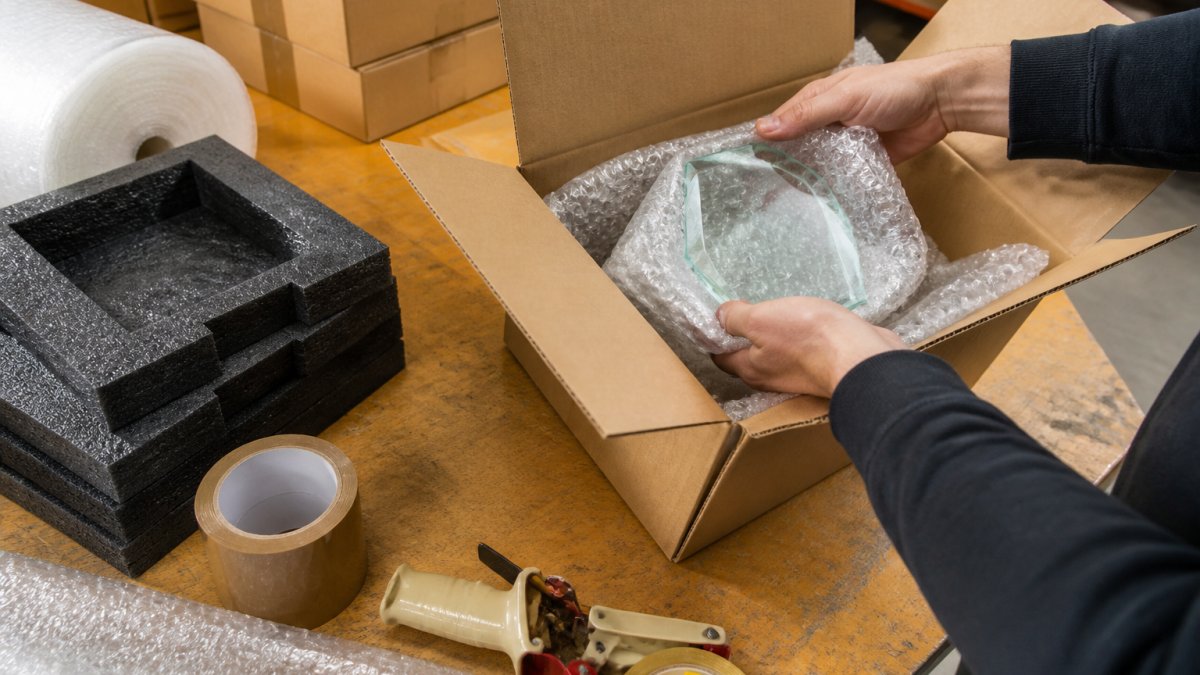
Double-Boxing, Void Fill and Why Movement Causes Damage
Double-boxing means placing the packed item inside a second, larger carton with cushioning between the two. The inner box protects the item; the outer box takes the knocks.
Void fill is any material that fills empty space so nothing rattles. Our guide to preventing cheap looking custom products has tips on keeping bespoke work looking its best while packing it safely.
Damage almost always comes from momentum. A parcel dropped at a depot sends the contents slamming into the wall of the box. Cushioning slows that impact and spreads it across a wider area.
Step 4: Bespoke Packaging Solutions for Small Business Sellers
Bespoke packaging solutions for small business do two jobs at once: they protect the item and they carry your brand. For sellers shipping custom-made goods, the unboxing is part of the product. Pair your packaging with the right service using our bespoke gift engraving buyer's guide.
Practical options that work at small volumes:
- Printed tissue and stickers for a branded reveal without custom tooling
- Foam inserts cut to the item so nothing shifts in transit
- Rigid mailer boxes for a premium feel on higher-value pieces
- Recycled padded envelopes for flat or small engraved items
Order packaging in line with your production runs. Overbuying boxes to hit a discount ties up cash and fills storage. Underbuying means a rush order mid-fulfilment.
Step 5: Courier Insurance for High Value Goods and Declared Value
Courier insurance for high value goods is not automatic, and standard cover may be capped below the value of bespoke work. Declared value is the figure you state for the item; it sets both the cover and the claim ceiling. This section sets out how cover, exclusions and claims generally work.
How Cover Is Structured
Parcel networks typically include a basic level of cover as part of the service, with limits that vary by carrier. Above that, you buy extra protection or use a specialist carrier whose terms suit valuable goods.
Declare too low and you save on the premium but cap your recovery. Declare too high and you may pay more than the item is worth, and some carriers ask for evidence of value on higher-value claims. The sensible approach is to declare the replacement cost of the item, not the sale price and not a round number.
Common Exclusions to Check
Read the exclusions before you ship, not after. The list below covers the ones that catch bespoke sellers most often:
- Glass, china and ceramics, often excluded or limited
- Antiques and fine art, usually needing a specialist policy
- Items packed by the sender, where inadequate packing voids the claim
- Electronics with no proof of condition at dispatch
- Prohibited or restricted items, which vary by carrier
- Consequential loss, such as lost profit from a missed deadline
If your item falls into an excluded category, either use a specialist carrier or accept that the standard cover will not respond. Do not assume a higher declared value overrides an exclusion.
Evidence to Gather Before You Ship
Claims go more smoothly with evidence gathered at the point of dispatch. Build a simple routine:
- Photograph the item from several angles before packing, with a scale reference if size matters.
- Photograph the packed item inside the box, showing the cushioning and void fill.
- Photograph the sealed box with the label visible.
- Keep the receipt or invoice showing the item's value.
- Retain the tracking number and booking confirmation.
This takes a few minutes and is the difference between a straightforward claim and a disputed one.
What to Do When a Claim Is Needed
Report damage within the carrier's stated window, and keep the original packaging in case it is needed for inspection. Do not repair or dispose of the item before the claim is assessed. Submit the photographs, the value evidence and the tracking details together, and keep a copy of everything you send.
If the carrier rejects the claim, ask for the specific reason in writing and check it against the exclusions you reviewed at booking. Many rejections come down to packing or a missed reporting window, both of which are avoidable with the routine above.
Step 6: Plan Collection and Delivery Around Made-to-Order Timelines
Collection and delivery for made-to-order goods need to work backwards from the deadline. Engraving takes time, and a courier booked before the item is finished just adds stress.
Work out your critical path:
- Confirm the design and sign off the proof
- Allow production time for engraving and finishing
- Pack and photograph the finished item
- Book collection for the day after packing completes
- Add transit time and a buffer for the delivery date
For a film shoot with a fixed date, the buffer matters most. Build in extra time before the deadline.
For clients based at a distance, collection and delivery planning follows the same steps, with transit time as the main variable.
Step 7: Book Your Bespoke Engraving and Delivery Plan with FOG Creative
The final step is the simplest: hand the whole job to one team and let the production and delivery plan sit together.
Our background in the film industry means we understand deadlines that cannot slip. You can also read our guide to engraving services near North West London before you book.
To get moving, send us your item details, quantities and target date. We will come back with a quote and a realistic delivery plan.
Shipping bespoke goods safely is a chain, and every link has to hold: accurate measurements, the right carrier, proper packing, sensible insurance, and a timeline with room to breathe.
At FOG Creative, we take the guesswork out of the last mile.
Frequently Asked Questions
How do I package fragile bespoke items for courier transit?
Wrap the item in at least two layers of bubble wrap, then place it in a rigid inner box with no room to move. Fill gaps with foam, air pillows or crumpled paper, then put that box inside a larger outer box with 5cm of cushioning on every side. Seal all seams with packing tape. Label the parcel fragile, but treat the packaging as the real protection, because couriers sort parcels mechanically and a label will not stop impact. For engraved glassware, china or awards, keep the heaviest part at the bottom of the box.
What is the best way to arrange courier insurance for high value goods?
Declare the full replacement value when you book, and check the carrier's standard liability limit before you do. Standard parcel cover may be lower than the value of custom-made items, so check the terms and consider enhanced cover or a specialist carrier for anything expensive. Keep photographs of the item before packing, retain the receipt or invoice, and save the packaging until delivery is confirmed.
Do I need a specialist courier for custom-made products?
Not always. A standard parcel courier handles most small engraved items, pet ID tags and personalised gifts without issue. Use a specialist carrier when the item is oversized, unusually shaped, extremely fragile or of higher value, such as framed artwork, large engraved signage or one-off film props. Pallet freight suits heavy or bulky consignments. The deciding factors are size, weight, value and how easily the item can be replaced if it is damaged.
How can I reduce shipping costs for a small bespoke business?
Measure and weigh accurately so you are not overpaying on a higher band, and pack items into the smallest box that still protects them, since many carriers charge by volumetric weight. Compare two or three courier services per parcel rather than defaulting to one, and consolidate multiple orders going to the same area where possible. Custom-sized boxes can help reduce both damage and wasted space. Ordering packaging in bulk and booking collections rather than dropping off also trims costs over time.
